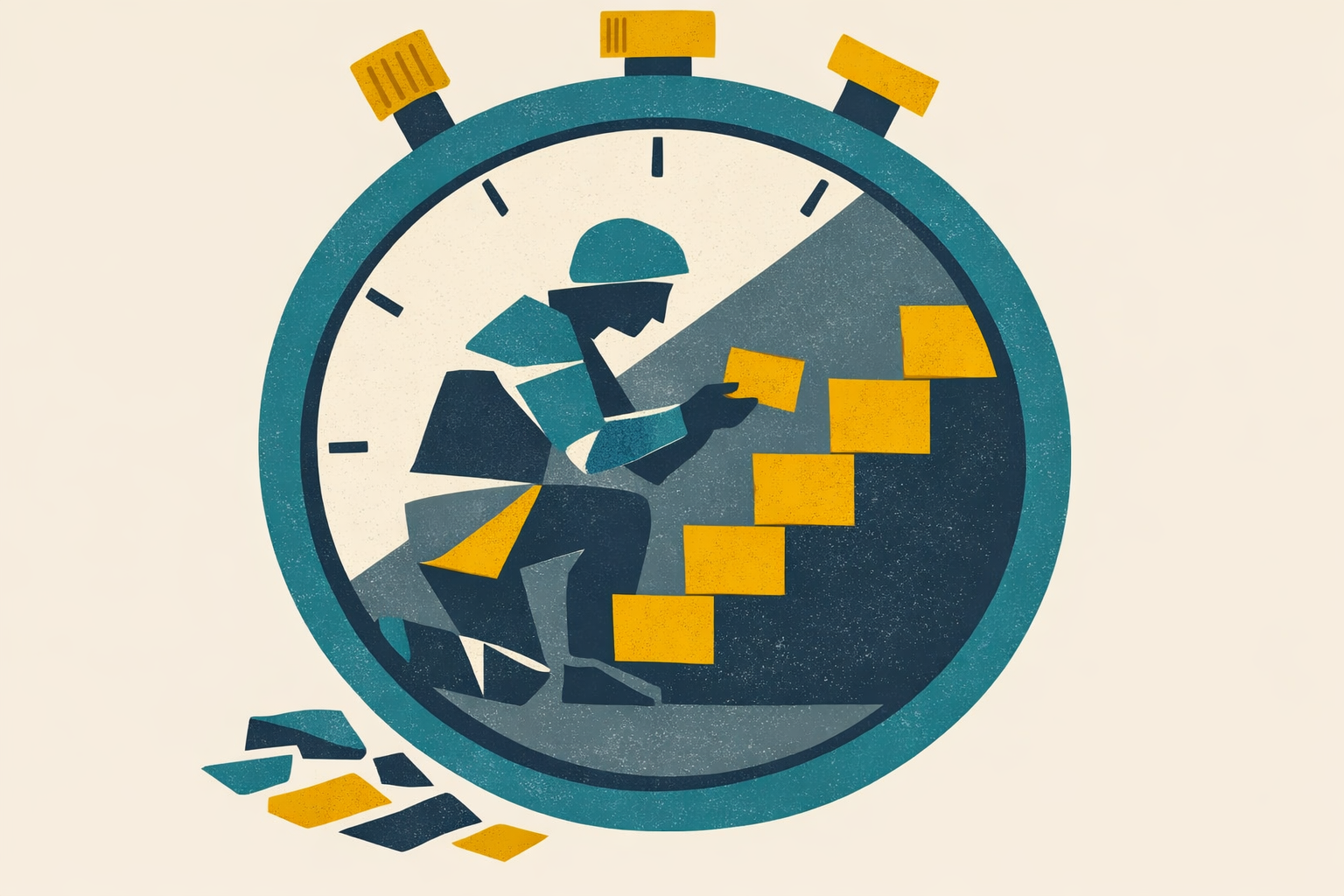
You are halfway through an interview when the interviewer changes the scenario: “Assume the budget is cut by 20%. What would you do in the first 30 days?” You understand the domain and you have done similar work, but you feel your thoughts scatter. You start speaking, then backtrack, then add a caveat, and the answer becomes harder to follow than it needs to be.
This moment is common in hiring conversations. It is less about finding the perfect solution and more about whether you can stay coherent when the situation shifts. The challenge is not intelligence. It is mental organization under time pressure.
Why this interview situation is more complex than it appears
In a thinking under pressure interview, the problem is rarely the question itself. The problem is that the question arrives with constraints: limited time, incomplete data, and the social pressure of being evaluated. You are expected to reason in public, not just reach an answer privately.
There is also a structural difficulty: many interview questions mix levels. They ask for strategy (“what would you do”), prioritization (“what first”), communication (“how would you align stakeholders”), and risk management (“what could go wrong”) in one prompt. Candidates often treat it as a single question and respond with a single stream of thought, which makes the answer feel unstructured.
Common preparation often fails because it is built around recall. People memorize stories, frameworks, and “good answers.” Under interview stress, recall is less reliable, and the mind reaches for whatever is most accessible, not what is most relevant. The result is a response that may be correct in parts but hard to follow as a decision narrative.
Takeaway: The complexity is not the scenario. It is the need to structure thinking while speaking, under constraints you cannot control.
What recruiters are actually evaluating
Interviewers do not expect candidates to solve a business in five minutes. What they are actually evaluating is whether your reasoning can be trusted when conditions are imperfect. That is why the same candidate can look strong in prepared questions and less convincing in a thinking under pressure interview.
Decision-making: Recruiters listen for how you choose a path, not whether you list every possible option. A candidate who can say, “Given the constraint, I would prioritize X over Y because…” signals an ability to commit and move forward. Wavering can be appropriate, but only if it is tied to explicit uncertainty and a plan to resolve it.
Clarity: Clarity is not a presentation skill in this context. It is evidence that you understand what matters. Interviewers notice whether you can name the core objective, define terms, and keep the answer anchored. If your response keeps shifting goals, the interviewer cannot tell what you are optimizing for.
Judgment: Judgment shows up in what you exclude. Candidates under pressure often over-include: more context, more edge cases, more disclaimers. Recruiters interpret that as risk aversion or lack of prioritization, even when the intent is to be thorough.
Structure: Structure is the bridge between a good idea and a credible answer. A simple signpost (“I’d look at this in three steps”) helps the interviewer follow you and helps you manage your own cognitive load. Without structure, even strong content can sound improvised.
Takeaway: Recruiters are testing whether your reasoning is usable: can they follow it, can they trust it, and can you make choices with limited information.
Common mistakes candidates make
Most mistakes in pressure performance are subtle. Candidates rarely collapse completely. Instead, they deliver answers that are partially correct but less persuasive than they could be.
Starting before framing the problem: Under time pressure, candidates often begin with tactics (“I’d schedule meetings,” “I’d pull the data”) without stating what they are trying to accomplish. The interviewer then has to infer your goal, which increases the chance of misalignment.
Over-indexing on a favorite framework: Frameworks can help with mental organization, but in a thinking under pressure interview they can become a crutch. When a candidate forces a generic model onto a specific scenario, the answer sounds rehearsed and misses the nuance the interviewer is probing.
Using disclaimers as a substitute for prioritization: “It depends” is sometimes true, but it is rarely sufficient. Candidates use it to protect themselves from being wrong, but recruiters often hear it as indecision. A better approach is to name the dependency and then choose a path based on a reasonable assumption.
Losing track of the question: This happens when the candidate tries to be comprehensive. They explore a side issue, then another, and by the end the interviewer is unclear whether the original prompt has been answered. In many interviews, the negative signal is not the tangent itself but the absence of a return to the main thread.
Answering at the wrong altitude: Some candidates stay too high-level, offering principles without operational steps. Others get stuck in details and never articulate the decision logic. Recruiters look for the ability to move between levels: state the principle, make the choice, then show how it would translate into action.
Takeaway: The most common failures are not knowledge gaps. They are failures of framing, prioritization, and staying anchored to the prompt.
Why experience alone does not guarantee success
Senior candidates often assume that years of work will translate into strong interview performance. Sometimes it does. But experience can also create predictable traps, especially in interviews designed to test reasoning under constraint.
First, experienced professionals may rely on pattern recognition. In real work, that is efficient. In an interview, it can cause premature closure: you identify the scenario as “just like” something you have seen and start answering before confirming the key constraints. When the interviewer’s scenario differs in one important way, your answer can drift off target.
Second, seniority can increase the urge to qualify everything. Leaders are trained to anticipate risk and to avoid overpromising. Under interview stress, that habit can turn into a stream of caveats that obscures your actual point of view. Recruiters are not looking for certainty, but they do want a clear stance.
Third, experience can lead to an assumption that credibility will carry the answer. In practice, interviewers still need to hear the reasoning. If the logic remains implicit, they may interpret the response as hand-waving, even if you could execute well on the job.
Finally, many senior candidates have not practiced being evaluated in real time. They are used to influencing decisions over weeks, with data, allies, and context. A thinking under pressure interview compresses that into minutes. The skill is adjacent to leadership, but not identical.
Takeaway: Experience helps with content, but interviews reward explicit reasoning. Seniority can create habits that reduce clarity when time is limited.
What effective preparation really involves
Preparation that improves mental organization is not primarily about collecting more answers. It is about building a repeatable process for thinking out loud. That process has to work when you are slightly uncomfortable, because that is when it is needed.
Repetition with variation: Practicing the same story repeatedly can improve delivery, but it does not train pressure performance. Better practice uses varied prompts that force you to re-structure on the fly: different constraints, different stakeholders, different trade-offs. Over time, you learn to create structure quickly rather than recite content.
Deliberate constraint practice: Many candidates practice in ideal conditions: unlimited time, quiet room, no interruptions. Interviews are not like that. Practice with a timer, and practice answering in two passes: a short structured answer first, then a deeper layer if asked. This trains you to be coherent even if the interviewer cuts you off or moves on.
Feedback on structure, not just content: Most peer feedback focuses on whether the answer sounds “good.” More useful feedback is diagnostic: Did you define the goal? Did you make an explicit choice? Did you provide a rationale? Did you close the loop to the question? These are observable behaviors you can improve.
Building a small set of flexible signposts: You do not need many frameworks. You need a few signposts that can adapt to different questions. For example: “objective, constraints, options, decision, risks.” Or: “diagnose, prioritize, execute, communicate.” The point is not the template itself, but the habit of naming the structure before you fill it in.
Practicing recovery: In real interviews, you will sometimes lose the thread. Preparation should include recovery moves that do not sound defensive: “Let me restate the question to make sure I’m answering it,” or “I’ll summarize where I am and then give my recommendation.” Recovery is part of thinking under pressure, not evidence of failure.
Takeaway: Effective preparation trains a process: framing, structuring, choosing, and summarizing under time constraints, with feedback that targets observable behaviors.
How simulation fits into this preparation logic
Simulation can help because it adds realism and repetition without relying on a single helpful friend or a one-off mock interview. Platforms such as Nova RH are used to run interview scenarios that mirror the pace and ambiguity of real conversations, making it easier to practice thinking under pressure interview responses and review where structure breaks down.
Organizing your thoughts under pressure is not about sounding polished. It is about making your reasoning legible when the question is messy and time is limited. Recruiters tend to trust candidates who can frame the problem, choose a path, and explain trade-offs without getting lost in qualifiers. With practice that emphasizes realism, variation, and feedback on structure, pressure performance becomes more consistent. If you use tools at all, use them to simulate the conditions you find difficult, not to collect more scripted answers.