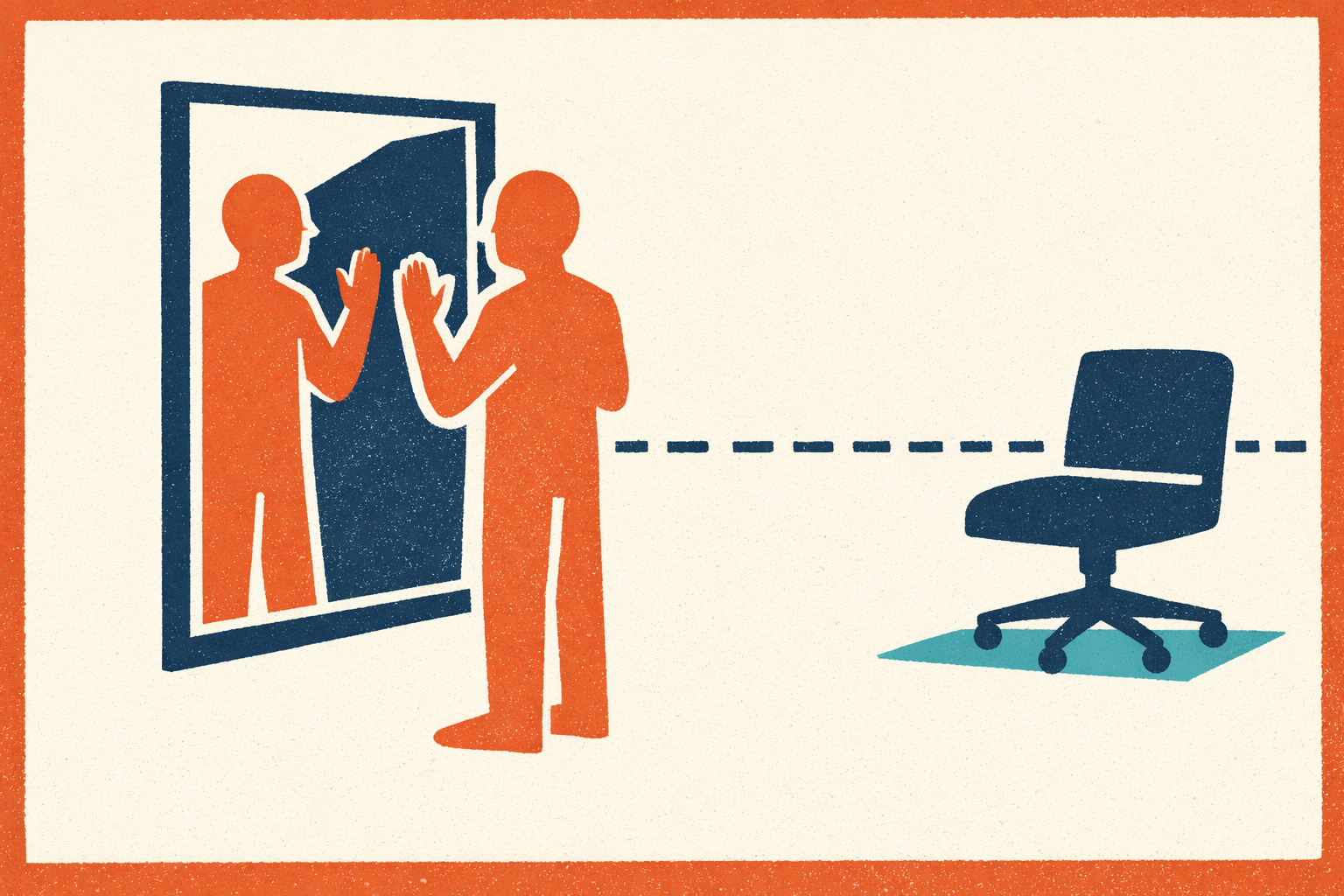
You join a video interview on time. The recruiter is polite, brief, and already scanning your resume. After two minutes of context, you get the first question: “Walk me through a decision you made that didn’t work out.” You have an answer ready because you rehearsed it alone. Still, the exchange feels different than expected. The follow-up comes faster, the interviewer interrupts to clarify, and your story starts to drift.
This gap is common. Many candidates do enough preparation to feel ready, but not the kind that holds up when someone is actively evaluating them. The difference is rarely effort. It is usually method.
Why this interview situation is more complex than it appears
An interview is not a recital. It is a live, time-bounded conversation in which your listener is making trade-offs: signal versus noise, confidence versus accuracy, and depth versus pace. Even simple questions become structurally difficult because the interviewer controls the direction. They can narrow the scope, challenge assumptions, or move on before you reach your planned point.
Common preparation fails because it assumes stable conditions. Solo interview practice often treats questions as prompts with one “best” response. Real interviews behave more like branching paths. The interviewer’s follow-ups change what counts as relevant, and your ability to adapt becomes part of the evaluation.
Another complication is cognitive load. You are managing content, tone, and timing while reading cues from someone whose priorities you do not fully know. Practicing alone does not reproduce that load, so it can overestimate readiness.
What recruiters are actually evaluating
Recruiters and hiring managers are not scoring you on how impressive your experiences sound in isolation. They are looking for evidence that you can operate in their environment with limited context, competing constraints, and imperfect information. That evidence shows up in how you think aloud, not just what you claim.
Decision-making is visible in the choices you highlight and the alternatives you considered. Strong candidates can explain why they chose a path, what they traded off, and what they would do differently with the benefit of hindsight. Weak answers either skip the decision entirely (“we decided to…”) or describe a decision as inevitable.
Clarity is not about being polished. It is about being easy to follow under time pressure. Recruiters listen for a clean problem statement, a coherent sequence, and a conclusion that matches the question. If the listener has to assemble your point, they will assume you communicate the same way at work.
Judgment shows up in what you emphasize. Two candidates can describe the same project; one signals maturity by discussing risk, stakeholder impact, and constraints, while the other fixates on tools or personal heroics. Recruiters infer judgment from your framing: what you think matters.
Structure is the quiet differentiator. Interviewers often meet several qualified candidates. Structure helps them compare. When you answer in a way that is easy to summarize, you make their job simpler. When your answer is diffuse, they may conclude you are diffuse.
Common mistakes candidates make
Most interview mistakes are subtle. They are not obvious blunders; they are small misalignments that accumulate across questions and reduce confidence in the candidate.
One frequent issue is answering the first version of the question, not the one being asked now. An interviewer might shift from “Tell me about a conflict” to “What did you do in the moment?” Candidates who continue with background detail signal that they cannot adjust in real time.
Another is over-indexing on completeness. Candidates sometimes try to include every relevant detail to prove credibility. The result is a long answer with no clear center of gravity. In recruiter logic, this can read as poor prioritization. A better approach is to choose a thread and make it legible, then offer details if asked.
Candidates also underestimate how often interviewers test for ownership. Phrases like “we did” are normal in collaborative work, but they can become evasive if you never specify your role. The interviewer is trying to map accountability. If they cannot, they will assume your contribution was smaller than you imply.
Finally, many people practice “safe” stories. They pick examples with clean outcomes and minimal ambiguity. This can backfire. Recruiters often learn more from how you discuss uncertainty, trade-offs, and mistakes than from a flawless win. A story that includes a constraint you could not control, and how you responded, tends to be more credible.
Why experience alone does not guarantee success
Senior candidates are often surprised when interviews feel harder than expected. They have led teams, shipped products, closed deals, or managed crises. Yet interviews compress years of work into short, comparable narratives. That compression is a distinct skill.
Experience can also create false confidence. When you have solved real problems for a long time, it is tempting to assume you will “just talk through it.” But interviews reward explicit reasoning. A senior person may skip steps because the logic feels obvious to them. The interviewer, hearing only conclusions, cannot verify the quality of the thinking.
Another limit is context. In your current role, colleagues know your track record and the constraints you operate under. In an interview, you have no such credit. You must establish context quickly, choose what to omit, and still sound grounded. Seniority helps with substance, but it does not automatically produce concise, comparable answers.
There is also an emotional factor. Experienced professionals sometimes have more at stake: compensation expectations, identity, or a narrative about their career trajectory. That pressure can narrow attention and make answers more defensive. Preparation that includes realistic friction helps reduce that effect.
What effective preparation really involves
Effective preparation is less about memorizing answers and more about building reliable performance under variation. That requires repetition, realism, and feedback, not just reflection.
Repetition matters because interviews test recall under pressure. A good story you have told once may fall apart when interrupted or when asked to quantify impact. Repeating the same core examples in different forms builds fluency. You want to be able to deliver a two-minute version, a five-minute version, and a version focused on a specific competency without sounding rehearsed.
Realism means practicing with the constraints that make interviews difficult: limited time, unpredictable follow-ups, and the need to recover from a weak start. A mock interview is useful when it includes interruptions, probing questions, and moments where the interviewer challenges your interpretation. Practicing only the “ideal” version of your answer trains you for a situation that rarely occurs.
Feedback is the part candidates most often skip because it is uncomfortable and inconvenient. Yet it is where improvement happens. You need someone to tell you when your answer lacks a clear point, when you are burying the decision, or when your explanation sounds like justification. If you cannot get a live partner, you can still create feedback loops by recording yourself and evaluating with specific criteria: Did I answer the question in the first sentence? Did I name the trade-off? Did I quantify results appropriately? Could someone summarize my answer in one line?
It also helps to practice methods rather than scripts. For example, when asked a behavioral question, start by stating the situation and the decision you owned, then add only the context required to understand the constraints. When asked a technical or analytical question, outline your approach before diving in, so the interviewer can follow your reasoning. These are practice methods that generalize across questions, which is why they hold up better than memorized lines.
As a final check, pressure-test your preparation with variation. Take a story you like and answer it from a different angle: focus on failure instead of success, stakeholders instead of execution, or trade-offs instead of outcomes. Interview rehearsal that includes variation reduces the risk of freezing when the question is unfamiliar.
How simulation fits into this preparation logic
Simulation can add consistency and realism when it is difficult to schedule repeated live practice. Platforms such as Nova RH can support solo interview practice by introducing structured prompts, time constraints, and repeatable scenarios that make it easier to practice under pressure and review performance over multiple sessions.
Practicing alone is not useless, but it is often incomplete. Interviews are interactive evaluations of judgment, structure, and clarity, not just experience. Preparation that works tends to look less like writing answers and more like training: repeated runs, realistic friction, and feedback that forces you to adjust. If you want a neutral way to add structure to your interview rehearsal, you can consider a simulation platform at the end of your preparation plan.